Clinical Exercise: Lachman Test
Scenario:
You are the sports medicine physician on call at a Ravens game when one of the players rapidly decelerates and tries to execute a quick change in direction to reach the ball. The player collapses clutching his knee and you are called onto the field with the player reporting pain from his right knee.
Diagnosis:
You immediately suspect injury to the ligaments of the knee as one of the most common causes for pain from the knee from a sports injury. Also, given the stop-turn motion you observed the player perform prior to collapse, you also suspect an anterior cruciate ligament (ACL) injury. Before swelling can impede your ability to test for injury of the knee, you have the patient sit back so you can administer a Lachman Test for function of the ACL.
Mechanism:
The ACL stabilizes the knee preventing anterior translation of the tibia on the femur. This is due to the anterior attachment of the ligament on the tibial plateau and the posterior attachment to the lateral femoral condyle. A ruptured ACL will result in the knee being able to translate anteriorly.
The Lachman test is performed with the knee at 20-30 degree flexion angle of the joint. At this angle, the ACL is maximally engaged in preventing anterior translation while other ligaments are minimally engaged. This makes the Lachman test the best method to determine a rupture of the ACL.
Other tests, such as a Pivot Shift Test or Anterior Drawer Test also test for ACL function, but the Lachman Test is now considered the most reliable and sensitive clinical test for ACL rupture over the Anterior Drawer Test.
Treatment (perform these steps on the dissected knee of the donor in a mock-procedure):
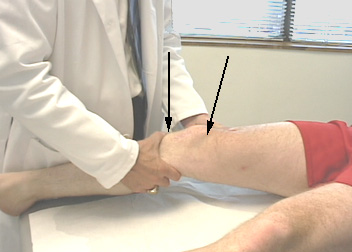
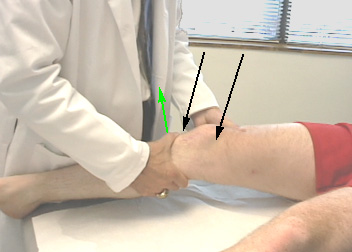
1) On the patients uninjured knee (simulated with the ligaments of the donor dissected knee joint intact) flex the leg to a 20-30 degree angle relative to the femur.
2) Place one hand behind the patient's tibia with the thumb of that hand positioned on the tibial tuberosity.
3) Place the other hand holding the patients thigh.
4) Keeping the patient's thigh steady, pull anteriorly on the tibia.
The intact ACL should prevent anterior translation of the tibia relative to the femur with a firm endpoint to any slight movements felt.
The uninjured knee serves as a reference for normal movement of the knee in the patient, and a comparison for whether the injured knee exhibits excessive anterior translation (more than 2mm compared to the uninjured knee).
5) Move to the 'injured' knee.
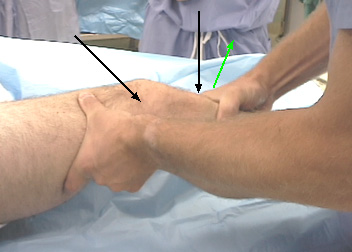
Simulate an ACL rupture injury by transecting the donor ACL with scissors before repeating the test.
6) On the 'injured' knee repeat the Lachman Test steps above.
With the ACL ruptured the tibia translates anteriorly as much as 10mm, with a soft or mushy endpoint to the movement.
Outcome:
Your on-field diagnosis (along with several other tests for other ligament function) indicate the Raven's player has suffered an ACL rupture.
The player is transferred to the University of Maryland Medical System hospital for further evaluation. Surgical intervention is performed in order to repair ligament function. Following recovery and rehabilitation the Raven player returns to the sport participating in another Superbowl win for the team.
Images from eMedicine